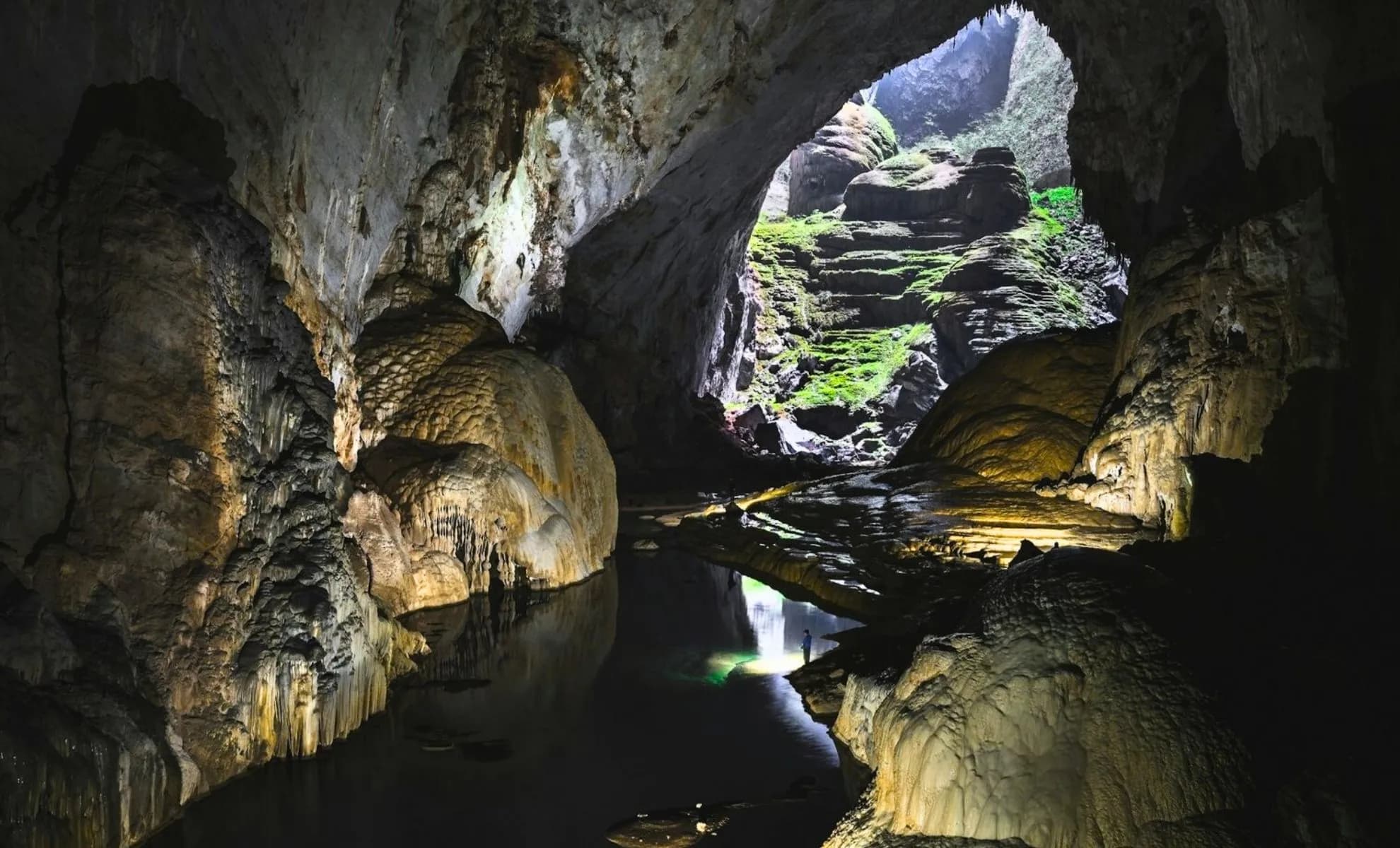
What scientists discovered inside was not just a massive hollow, but a self-sustaining ecosystem. Cool air inside and warm humid air outside create fog that turns into internal clouds, forming a unique microclimate. Parts of the roof collapsed hundreds of thousands of years ago, opening huge skylights through which sunlight reaches the floor of the cave. In those places, tropical forests grow.
More than 250 species of plants and animals have been identified here, including blind fish, transparent crustaceans and rare fungi adapted to the nutrient-rich environment. In more open areas of the cave, monkeys and birds from the surrounding jungle occasionally descend through the openings in search of food, creating a brief intersection between the underground and surface worlds.
Sơn Đoòng is over five kilometers long, 200 meters high and 150 meters wide — large enough to contain an entire city block of skyscrapers. Fossilized corals embedded in the walls show that this part of Vietnam was once submerged under an ancient sea. At the far end rises an 80-meter limestone formation known as the Great Wall of Vietnam. Beyond it lies an area that remains unexplored due to logistical challenges.